The Desert Tapestries of Louise Nevelson

Guest Lecture by Ann Lane Hedlund, “The Desert Tapestries of Louise Nevelson: 1972-1997,” Wednesday, November 14 at 7 p.m. in Tucson, Arizona.

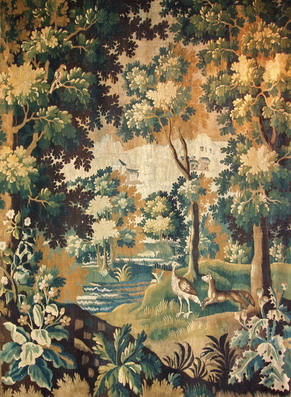
Dr. Hedlund will present a richly illustrated talk about a unique series of handwoven tapestries designed by world renowned sculptor/collagist Louise Nevelson, orchestrated by Gloria F. Ross, and woven under the direction of Archie Brennan at the Dovecot Studies in Edinburgh, Scotland. The translation of Nevelson’s torn paper collages into large-scale woven works represents an intriguing collaboration. Inspired by a visit from the East Coast artist to the American Southwest, the resulting artworks were evocatively named “Desert” (MFA-Boston), “Dusk in the Desert,” “Landscape,” “Mirror Desert,” “Night Mountain,” “Reflection,” and “The Late, Late Moon.” These are also illustrated and described in Hedlund’s 2010 book, Gloria F. Ross & Modern Tapestry (Yale University Press).


Recital Hall adjacent to the Louis Carlos Bernal Gallery
Pima Community College, West Campus
Center for the Arts Complex
2202  West Anklam Road
Tucson, AZ 85709
520-206-6942


Please feel free to forward this email to a friend.

Center for the Arts Box Office hours Map and Directions Accessibility    Information

“Where’s That Textile From?!”

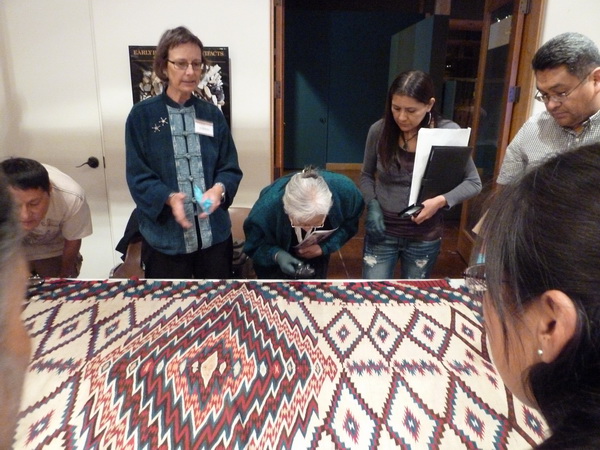
On Thursday, November 8, 2012, textile expert Ann Lane Hedlund (GFR Center’s director) will present a free public talk at the Arizona State Museum (ASM) in Tucson, on the campus of the University of Arizona. In “Where’s That Textile From and When Was It Made? An Illustrated Talk on Textiles from Mexico and the Southwestern U.S., she will demonstrate how you can tell the difference between Pueblo, Navajo, Mexican, and Spanish-American textiles. Using examples from ASM’s renowned collection and from other museums, Dr. Hedlund will explain why certain designs and technical features are useful in identifying and dating blankets and rugs from the Greater Southwest. Come learn how historical events, cultural traits and technical details influenced weavers to fashion their work in certain ways, and you too could answer the question, “Where’s that textile from?” Refreshments served before the talk in ASM lobby, 6–6:40 p.m; the talk takes place in CESL auditorium, 6:45–8 p.m.

A textile analysis workshop led by Ann Hedlund

A textile analysis workshop led by Ann Hedlund

at Museum of Indian Arts and Culture in Santa Fe

at the Museum of Indian Arts & Culture, Santa Fe

This program presented as part of the ongoing celebrations of Arizona State Museum’s Many Mexicos exhibit.

Textile Analysis Workshops are offered

Where to begin and how to proceed with understanding an unknown textile from the American Southwest, whether a Pueblo, Navajo or Spanish-American blanket, poncho or rug?  In this workshop we’ll cover fibers, yarns and dyes; loom techniques; weave structures; end, side and corner finishes. We will offer hands-on analysis of varied museum textiles under magnification, coupled with digitally illustrated discussions of useful traits for identifying and dating Southwest textiles. Open to collectors, curators, scholars, artists, and others; no prior analytical experience necessary but appreciation and careful handling of textiles is essential.”

In advance of publishing an online project called the Joe Ben Wheat Southwest Textile Database, Ann Hedlund and colleagues are offering a number of one-day workshops on Southwestern Textile Analysis. The first took place last March at the Museum of Indian Arts and Culture (MIAC) during the Navajo Studies Conference in Santa Fe, New Mexico. Taught by Hedlund and Museum of New Mexico registrar Cathy Notarnicola, with contributions from MIAC curator Joyce Begay-Foss, the workshop was deemed a success by its registrants, half of whom were Navajo weavers and the other half, museum curators.

_____

The next is offered during the annual meetings of the Textile Society of America, on Wednesday, September 19, 2012, at the National Museum of the American Indian in Washington, DC. Hedlund will teach again with Notarnicola and with NMAI conservator Susan Heald. There are still a few places open for participants and you do not have to register for the entire meetings. Click here for more information as this workshop will soon fill up.

_____

Other opportunities occur in Tucson, Arizona, when Hedlund gives a free public lecture, “Where’s That Textile From and When Was It Made? An Illustrated Talk on Textiles from Mexico and the Southwestern U.S.,” at Arizona State Museum on Thursday, November 8, and follows with two one-day workshops on Friday and Saturday, November 9 and 10. Those belonging to the Friends of the ASM Collections, or ASM’s membership group, or Tucson’s Navajo Textile Study Group will be given priority registration for the limited enrollment. Click here for more information about ASM’s member groups and contact Darlene Lizarraga at  dfl@email.arizona.edu to sign up for this workshop.

_____

In early April 2012, Hedlund will offer a workshop at the University of Colorado Museum to members of the Boulder Handweavers Guild. Contact David Johnson at jdjohnson81499@msn.com for more information on this one.

_____

Also, please watch for more activities related to the Joe Ben Wheat Southwest Textile Database as its online debut approaches before the end of 2012.

“Navajo Weaving: Then, Now, and in the Future.”

Wednesday, February 8, 12 noon
WILL Lunch and Learn
illustrated talk by Ann Lane Hedlund

“Navajo Weaving: Then, Now, and in the Future.”

Western New Mexico University, Global Resource Center, ABC Room, Silver City, New Mexico.

Free and open to the public, sponsored by the Western Institute for Lifelong Learning (WILL).

Navajo weaver Ason Yellowhair at work on a large rug (photo by Ann Hedlund)

Navajo weaver Ason Yellowhair at work on a large rug (photo by Ann Hedlund)

Tapestries Made After Paintings

Tapestry Weavers West is sponsoring an illustrated lecture by Dr. Ann Hedlund
ICB: Gallery 111
480 Gate 5 Road, Sausalito, California
Saturday, February 18, 2012
at 10:30 am

_____

Tapestries Made After Paintings:
From the Dovecot to Ganado, from Brennan to Begay

In the right hands, a tapestry made from a painting becomes a new and different work of
art.”

In each of the tapestry projects that éditeur Gloria Ross orchestrated, the interactions of the weavers and artists whom she included varied, and so did the woven results. Between 1970 and 1980, she and the Dovecot’s team of Scottish weavers, led by Archie Brennan, created forty-eight tapestries from designs by eight famous painters and sculptors (Jean Dubuffet, Helen Frankenthaler, Robert Goodnough, Adolph Gottlieb, Robert Motherwell, Louise Nevelson, Kenneth Noland, Jack Youngerman). From 1979 to 1997, she brought purpose-made designs by one painter (Kenneth Noland) to six individual Native American weavers who produced twenty-five unique tapestries. In addition she worked with French tapestry weavers throughout both periods, interpreting the work of more than a dozen American painters and sculptors into the woven medium.

_____

In this richly illustrated talk, Ann Hedlund will compare two of these enterprises—one in Scotland and one in the American Southwest—to open discussion about what can happen when a tapestry comes from a painted or collaged image.

_____

Questions? Contact Alex Friedman - 415.310.2460 /AQSFriedman@gmail.com

A few (of the many!) Summer/Fall tapestry events

On August 1-5, 2011, Navajo weaver Marilou Schultz is offering a workshop called “Weaving in the Pines” at Northern Arizona University in Flagstaff, AZ . For more information visit http://www.navajorugsart.com or call Marilou at (480) 332-2906.

On Saturday, August 6, 2011, author Ann Hedlund will give an illustrated talk, “Louise Nevelson and Archie Brennan: From Collage to Tapestry,” to the Santa Barbara Fibers Arts Guild in California. For more information, contact Jeanette Warren at artery2@verizon.net . On Wednesday, September 14, 2011, she will speak about Gloria Ross’s tapestry career in the “Lunch & Learn” program at WILL (Western Institute of Lifelong Learning) in Silver City, NM. On Wednesday evening, October 13, 2011, she will present “Gloria Ross & Modern Tapestry: Evolution of a Unique Arts Career” at the Museum of Fine Arts in Boston. For details, go to www.tapestrystudies.wordpress.org and visit the Events page.

The Amerind Foundation’s next weaving workshop with Navajo weavers Barbara Ornelas and Lynda Pete is scheduled for Oct. 31 – Nov. 4, 2011, with a warping workshop scheduled on Nov. 5. Lodging and meals at the Amerind in Dragoon, AZ, are available for participants. For more information, contact Carol at ccharnley@amerind.com

For other indigenous weaving workshops, visit Mary Walker’s website and http://www.weavinginbeauty.com/instruction.html . There are many from which to choose!

Planning for the upcoming 13th Biennial Symposium of the Textile Society of America TEXTILES AND POLITICS, to be held on September 19-22, 2012, in Washington, DC, is underway. TSA has announced that the online submission process for the CALL FOR PAPERS with a deadline of October 1, 2011, is now available at www.textilesociety.org.

CIETA (Centre International d’Etude des Textiles Anciens) will convene its General Assembly in Copenhagen, Denmark, on October 3-6, 2011. Watch for more information about this conference at http://www.cieta.fr/ .

For MANY other tapestry-related events around the country and world, visit the websites, join the memberships, and subscribe to the newsletters of the American Tapestry Alliance and the Textile Society of America.

Exciting international initiatives inaugurated

From Budapest, Hungary, Mr. Laszlo Valy and Ms. Ibolya Hegi have inaugurated several new Facebook initiatives that advance the cause of contemporary international tapestry weavers: https://www.facebook.com/Web.of.Europe and a closed Tapestry discussion group (for access, write to tapestryart@groups.facebook.com or tapestry@freemail.hu). Both projects are gaining attention from worldwide audiences. Congratulations to the organizers!

‘VIVE LA TAPISSERIE’

An exhibition of small format tapestries by S.T.A.R.* (Scottish Tapestry Artists Regrouped), titled ‘VIVE LA TAPISSERIE,’ will be shown at GALERIE LA TOUR MONTSALES, 12260 AVEYRON, FRANCE.

All exhibitors are past students or staff of the tapestry department of Edinburgh College of Art. Some makers have departed from the flat tapestry route but all acknowledge the debt they owe the Gobelin tradition.

16 July -  18 August 2011, every day 15 - 19h. Entry free. Bilingual full colour catalogue available - 5€ plus p+p Galerie la Tour, 12260 Montsalès, France

The full list of exhibitors is Sara Brennan, Amanda Gizzi, Linda Green, Fiona Hutchison, William Jefferies, Jo McDonald, Susan Mowatt, Paul R Penrice, Elizabeth Radcliffe, Anna Ray, Joanne Soroka, Lesley Stothers and Méabh Warburton.

www.galerielatourmontsales.com

info@galerielatourmontsales.com

Heard Museum programs continue . . .

. . . with the last two lectures in a series that accompanies the current exhibition, A Turning Point: Navajo Weaving in the Late 20th Century. Both illustrated lectures and an exciting workshop take place in the Encanto Room, at the Heard Museum in central Phoenix.

INTERWAR DYE REVIVALS and the Transition to a Fine-Art Market in Navajo Weaving”

Sunday, March 20, 2 pm - Dr. Jennifer McClerran focuses on the privately funded and government-sponsored vegetal dye–revival projects of the 1930s and 1940s. An examination of these revival initiatives demonstrates their role in Navajo weaving’s transition to the fine-art market.

As the World Turns: NAVAJO WEAVING JOINS THE ART WORLD”

Sunday, March 27, 2 pm - Curator Dr. Ann Hedlund will discuss the transition of Navajo weaving from home-grown craft to museum-quality art, as illustrated by the textiles featured in A Turning Point: Navajo Weaving in the Late 20th Century. She will underscore some of the growing trends among Native weavers/artists today.

In addition, don’t miss:

Heard Museum GUILD SHOP WORKSHOP

Monday, March 28, 1 pm - Acclaimed Navajo weaver D.Y. Begay will demonstrate the creation of art from textiles. Call Norma Jean Coulter at 602.279.7105 or e-mail njstar@cox.net for information.

For Heard Museum details, visit its lecture listings.

Heard Museum to exhibit Navajo textiles

A Turning Point: Navajo Weaving in the Late 20th Century features thirty-six textiles that epitomize the gradual change that took place in Navajo weaving from the 1970s into the 1990s, as a traditional craft transformed to include name artists exploring new aesthetics and showing in urban galleries.

Open to the public from February 5 through May 22, 2011, the exhibition draws from the renowned Santa Fe Collection, which was recently gifted by Dr. Charles and Linda Rimmer to the Heard Museum in Phoenix, Arizona. Among the premier Navajo weavers represented with work on the gallery walls are Barbara Ornelas and her aunt Margaret Yazzie; Ella Rose Perry; Sarah Paul Begay; Lilly Touchin; Genevieve Shirley; the late Elsie Wilson and her sister Sadie Curtis; Jason Harvey; Winnie James (aka Martha Smith); the late Larry Yazzie; and other accomplished artists.

This show examines how the perception of Navajo weaving as an art form grew out of the sociopolitical context of the twentieth century, particularly the civil rights movement of the 1960s, when Indian self-determination, Native sovereignty, the concept of the individual artist and the power of artistic expression gained prominence.”

For more about this exhibition, curated by anthropologist and textile expert Dr. Ann Lane Hedlund, and a related lecture series during Winter/Spring 2011, visit the Museum’s website by clicking HERE. For more about Dr. Hedlund’s lecture at the Heard on March 27, click HERE. Also, look for Hedlund’s fully illustrated essay about this splendid collection in the Spring 2011 issue of American Indian Art magazine.